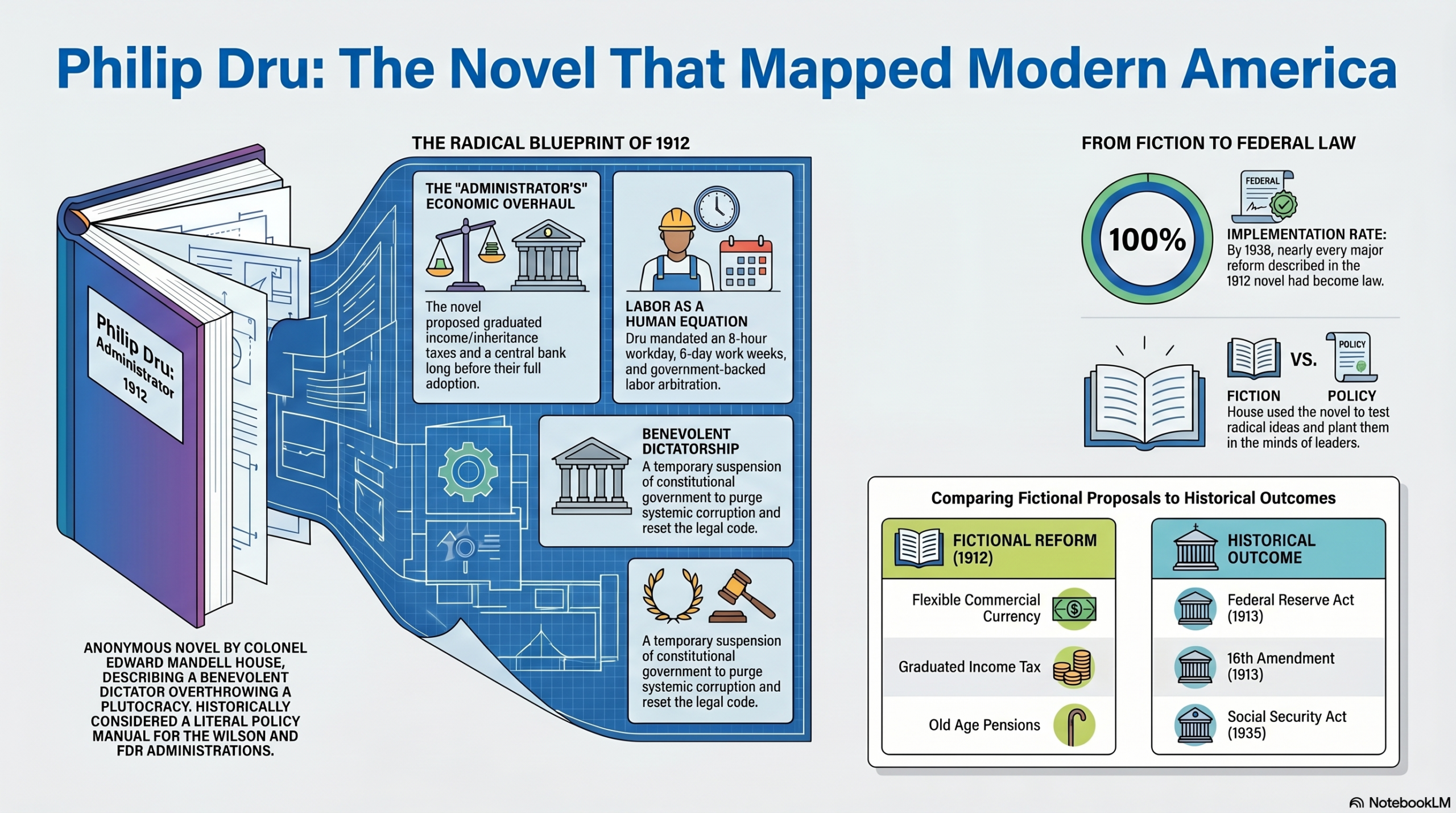
The Great Tug-of-War: Plutocracy vs. Progressivism in Philip Dru: Administrator
- The Core Conflict: The Few vs. The Many
In the world of Philip Dru: Administrator, the year 1920 represents a nation on the precipice. As a curriculum specialist, I want you to visualize the atmosphere of this era: it is a pressurized vessel where “luxury, dominant and defiant” in the great cities stands in jarring contrast to a population pushed to the edge of revolt.
The story opens with Philip Dru, a young West Point graduate, standing apart from the “triumphant blare of militarism.” Dru is a soldier with a heavy heart; he sees a Republic where civil institutions are debased by the power of money. Most poignantly, he feels his own profession is being “prostituted,” with the Army used for “petty conquests where the interests of wealth were at stake.”
The central tension of this narrative is a stark, bolded collision:
- The Bold and Forceful Few (Organized Capital): A wealthy elite that has consolidated power to the point of total control over the Republic’s civil and military institutions.
- The Sullen Masses: A vast group—laborers, farmers, and merchants—who see only a “gloomy and hopeless future” in a system that views them as expendable.
The text describes this asphyxiating grip of wealth in a passage that defines the stakes of our study:
“Wealth had grown so strong, that the few were about to strangle the many, and among the great masses of the people, there was sullen and rebellious discontent.”
This conflict is not merely a dispute over policy; it is an existential battle for the “human equation” against the supremacy of the dollar. Having identified these two warring camps, let’s define the political vocabulary they use to justify their actions.
- Defining the Terms: Plutocracy and Progressivism
To “grok” this story, you must understand that these are not just dry dictionary terms—they are the legal and moral frameworks that determine whether a family eats or starves.
The Political Spectrum of Philip Dru
Term Simple Definition The “So What?” (Why it matters to the learner)
Plutocracy A system where the state is controlled by the wealthy few for their own benefit. In this story, Plutocracy turns the law into a “legal shield” for property. It means the system is rigged so that wealth is protected while people are exploited.
Progressivism A movement seeking to reform society by prioritizing the “human equation” over capital. This represents the shift from “brute strength” to a “Spirit of Brotherhood.” It is the idea that the state’s primary job is to protect the person, not just the purse.
Government of Negation A strategy of using the law and courts to block any social change. This is the “So What” of elite control: the wealthy don’t need new laws; they just need to ensure nothing changes, keeping the masses in a state of “negation” and helplessness.
Exploitation The act of using labor (men, women, and children) for maximum profit and minimum cost. This is the lived experience of the Plutocracy. It treats a human being as an “inert commodity,” no different from a piece of coal or a lump of iron.
These forces are not abstract ideas floating in the air; they are the active machinery of a conspiracy managed by the “Architects of Inequality.”
- The Architects of Inequality: The Selwyn-Thor Conspiracy
The Plutocratic side of this tug-of-war is driven by a partnership between Senator Selwyn (the political brain) and John Thor (the financial muscle). Their goal was to govern with an “absolute hand” while hiding behind the curtain of democracy.
To maintain this “Government of Negation,” they employed three specific tactics:
- The Pool of 1,000 (The $10 Million Corruption Fund): Selwyn and Thor gathered 1,000 multi-millionaires, each contributing $10,000 to a “blind pool.”
- Primary Benefit: This massive, untraceable fund allowed them to “debauch the weak” and “mislead those that could be misled,” ensuring their puppet candidate, James R. Rockland, won the presidency.
- Control of the Judiciary: Selwyn focused on filling the Supreme Court with “safe and sane” justices.
- Primary Benefit: By controlling the court of last resort, the elite could “properly interpret” existing laws to protect wealth and strike down any reform as “unconstitutional.”
- Media Manipulation: Selwyn subsidized newspapers to “judiciously” attack opponents and even ran “progressive” candidates who were secretly under his control.
- Primary Benefit: This created an “invisible coil” around the public. By controlling the narrative, the elite kept the masses “ignorant and violent,” ensuring they fought each other rather than their true oppressors.
Having seen the secret plots of the elite, we must now look at the visible scars they leave on the American family.
- The Human Cost: Two Families in the Crosshairs
In our “learning narrative,” these stories serve as concrete evidence of what happens when a system prioritizes the dollar over the man. These are not just tragedies; they are systemic failures.
Zelda Turner and her son represent the abandonment of the virtuous citizen. Her husband, Len, died a “heroic death” saving a child from a motor car—the ultimate individual sacrifice.
- Systemic Failure: Despite Len’s virtue, the state provided no “succor.” Zelda was forced to work for “inadequate wages” until she became bedridden.
- The Result: A ten-year-old child became the sole support for a family of four. This illustrates a system that rewards brute strength but leaves the “weak and impractical” to perish without a social safety net.
Ben Levinsky’s family fled a Warsaw massacre only to find a different kind of violence in America.
- Systemic Failure: The Plutocratic system benefits from keeping the masses “ignorant and violent,” as seen in the race-mad mobs of Ben’s past and the “struggle for existence” in his present.
- The Result: In a system where “the dollar and not the man” counts, Ben found a “miserable travesty” of civilization that restricted the efficiency and opportunity of the many.
These human tragedies are what bridge Philip Dru’s military training to his decision to pursue a “new era”—shifting from a soldier of the state to an “Administrator” of humanity.
- The Progressive Response: Philip Dru’s Vision for Reform
Philip Dru’s goal was to dismantle the “Government of Negation” and replace it with a system where “the strong help the weak.” He proposed four significant reforms to solve the conflict:
- Federal Incorporation Act
- Before: Corporations were unregulated “monopolies of capital” that stifled competition and operated in total secrecy.
- After: Every corporation must have government and labor representatives on its board to ensure “publicity” and “protection.”
- Graduated Income Tax
- Before: Wealthy elites like Thor accumulated hundreds of millions untaxed, while the “sullen masses” bore the brunt of the nation’s costs.
- After: High incomes (up to 70%) are taxed to fund “old-age pensions” and “laborers’ insurance,” providing the “succor” Zelda Turner never had.
- Labor Representation and Wage Adjustment
- Before: Labor was treated as an “inert commodity” subject to the “caprice of the over-lord.”
- After: An “adequate wage” is legally required. Labor is no longer a tool; it is a partner in the “human equation.”
- Legal and Judicial Reform
- Before: A “grotesque” system with 3,600 judges (compared to only 200 in England) that was “debased by the power of wealth.”
- After: A simplified code understandable to the “ordinary lay citizen” and a judiciary stripped of the power to strike down laws based on elite interpretations of the Constitution.
Dru’s goal was to shift the nation from a “Government of Negation” to a “Spirit of Brotherhood.”
- Summary: The ‘So What?’ for the Aspiring Learner
The battle between Plutocracy and Progressivism in Philip Dru: Administrator is framed as the “next great battle for human emancipation.”
The Key Takeaway: This 1912 novel is more than a story; it was a blueprint. Written by Colonel Edward Mandell House—the “Invisible Operator” who never held office but served as Woodrow Wilson’s “second personality”—the ideas in this book became the real-world foundation for the New Deal twenty years later.
The primary insight for the learner is this: Political systems are not static. History is a progression of power from brute strength (the Stone Age) to intellectual strength used for selfish gain (the Plutocracy) to the final stage: the supremacy of mind and justice (Progressivism). As Dru concludes, the “human equation” must always be placed above the “insistent monopoly” of capital to ensure that the “Star of Bethlehem”—the spirit of love and brotherhood—can finally shine on a just society.
- “Philip Dru and the Blueprint of the New Deal.” Notebook: Philip Dru and the Administrative Blueprint of the New Deal, 13 May 2026.
- House, Edward Mandell. Philip Dru: Administrator: A Story of Tomorrow, 1920-1935. B.W. Huebsch, 1912. Project Gutenberg/Feedbooks.
- House, Edward Mandell. Philip Dru: Administrator: A Story of Tomorrow, 1920-1935. B.W. Huebsch, 1912. Project Gutenberg/Feedbooks (Text version).
- “Edward Mandell House — Biography for NotebookLM.” Notebook: Philip Dru and the Administrative Blueprint of the New Deal, 13 May 2026.
- “Q&A: Philip Dru, Edward House, and the FDR Connection.” Notebook: Philip Dru and the Administrative Blueprint of the New Deal, 13 May 2026.
- “Philip Dru: Administrator (1912) vs. FDR New Deal — Source Document.” Notebook: Philip Dru and the Administrative Blueprint of the New Deal, 13 May 2026.
- “Key Passages from Philip Dru: Administrator (1912).” Notebook: Philip Dru and the Administrative Blueprint of the New Deal, 13 May 2026.
- “Philip Dru: Administrator — NotebookLM Briefing Primer.” Notebook: Philip Dru and the Administrative Blueprint of the New Deal, 13 May 2026.
- “Philip Dru Reforms vs. FDR New Deal — Structured Comparison.” Notebook: Philip Dru and the Administrative Blueprint of the New Deal, 13 May 2026.
- “Timeline: Edward House, Philip Dru, Wilson, and FDR.” Notebook: Philip Dru and the Administrative Blueprint of the New Deal, 13 May 2026.