The Golden Ghetto and the Crypt: The Transpacific Lineage of American Power
Abstract
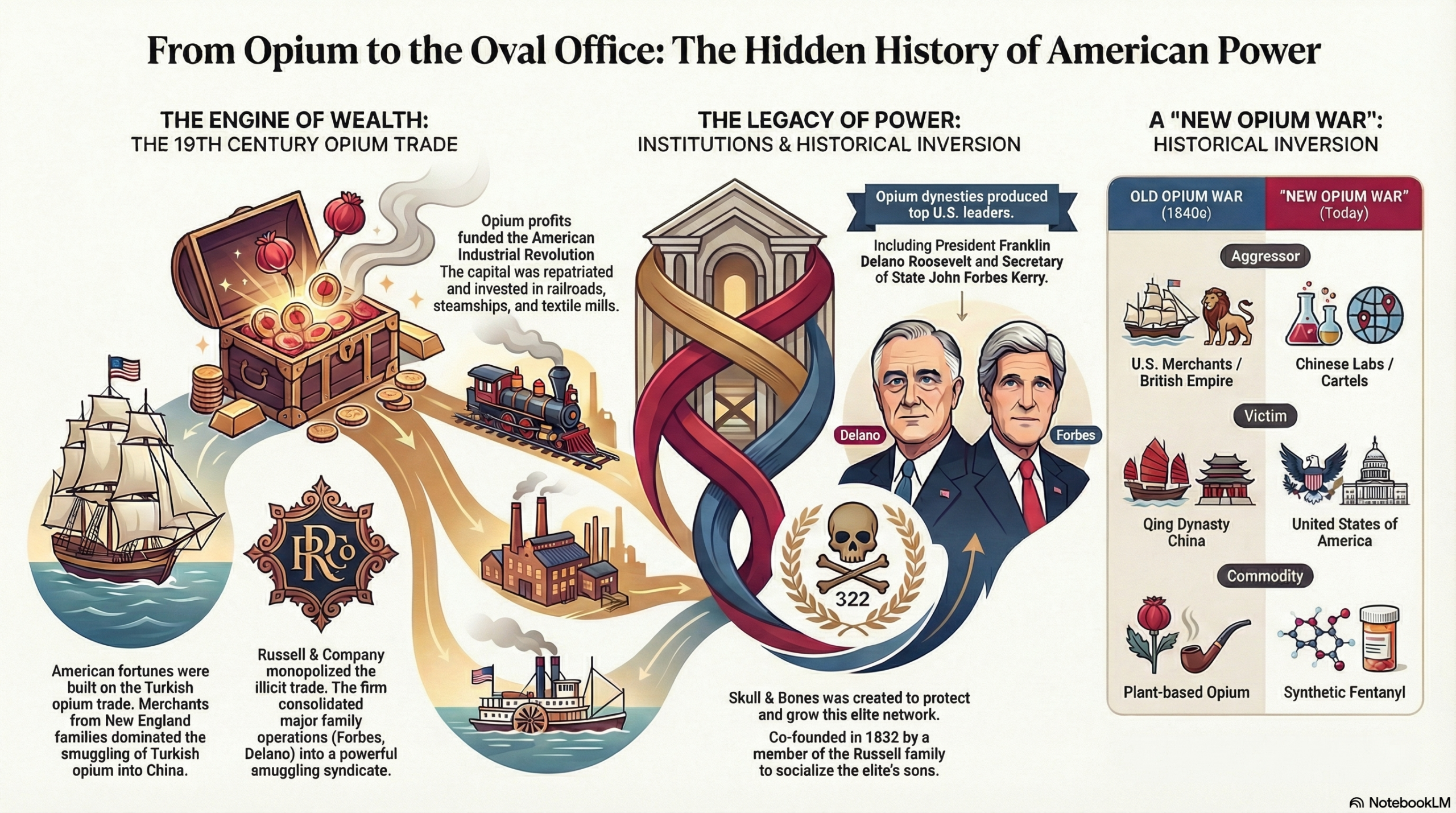
This report presents an exhaustive historical and geopolitical analysis of the foundational capital that underwrote the ascent of the American Eastern Establishment. By interrogating the archives of the “Old China Trade,” specifically the operations of Russell & Company and the Delano and Forbes families, we trace the transmutation of illicit opium profits into the respectable infrastructure of American industrialism, philanthropy, and political dynasty. The investigation reveals a continuous thread of influence connecting the Canton factories of the 1830s to the secret corridors of Yale’s Order of Skull and Bones, and ultimately to the highest offices of contemporary American governance. Furthermore, this report examines the cyclical nature of Sino-American narco-politics, positing that the current fentanyl crisis—often termed the “New Opium War”—represents a geopolitical inversion of the 19th-century trade that originally enriched the American elite.
Part I: The Architecture of Extraction — The Old China Trade
1.1 The Geopolitical Vacuum and the American Entry
To understand the rise of the American merchant elite, one must first reconstruct the geopolitical architecture of the early 19th century. The Qing Dynasty, regarding itself as the “Middle Kingdom,” operated under the Canton System, a restrictive trade protocol that confined all Western commerce to a small district of factories (warehouses) on the banks of the Pearl River in Guangzhou (Canton). For the British Empire, represented by the East India Company (EIC), this system was a stifling impediment to free trade. The British thirst for Chinese tea, silk, and porcelain had created a catastrophic trade deficit, as the Chinese merchants—the Hong—accepted only silver in payment.1
The Americans, arriving late to this theater following their independence, found themselves in a precarious position. They lacked the colonial infrastructure of the British and the military protection of the Royal Navy. However, they possessed two critical advantages: neutrality and navigational speed. American “clipper” ships, built for velocity rather than capacity, could outrun both pirates and imperial patrols.
Into this arena stepped a cohort of young men from New England—scions of seafaring families from Boston, Salem, and New Bedford. They discovered that while they could not compete with the British in the importation of Indian opium (controlled by the EIC monopoly), they could dominate the market for Turkish opium. This “Smyrna trade,” involving the acquisition of opium in Turkey and its transport to the Pearl River Delta, became the primary engine of American capital accumulation in the antebellum period.2 The profit margins were staggering, often exceeding 1,000%, providing the raw liquidity that would later fuel the American Industrial Revolution.
1.2 Russell & Company: The Corporate Behemoth
The central protagonist in this narrative is Russell & Company, a firm that would grow to become the largest and most powerful American trading house in China. Founded in 1824 by Samuel Russell (1789–1862) of Middletown, Connecticut, the company was the result of a strategic evolution of capital.3
Samuel Russell arrived in Canton in 1819, representing the Providence firm of Samuel Russell & Co. The economic landscape of the United States was bleak, ravaged by the Panic of 1819. In a pattern that would repeat throughout American history, domestic economic stagnation drove capital abroad in search of higher yields. Russell’s initial venture struggled, but the expiration of his contract in 1824 led to a new partnership with Philip Ammidon, creating Russell & Company.4
The firm’s ascension to dominance was not organic; it was engineered through consolidation. The Perkins syndicate of Boston, led by the formidable “Merchant Prince” Thomas Handasyd Perkins and his agent John Perkins Cushing, was the primary American competitor. The Perkins family had deep roots in the trade, smuggling opium and furs with ruthless efficiency. In 1830, realizing that competition was eroding margins, Cushing orchestrated a merger. The operations of Perkins & Company were absorbed into Russell & Company, creating a monopoly on American opium trafficking.2
This merger brought together the “Boston Brahmin” families—the Forbes, Sturgis, Cabot, and Delano clans—under a single corporate umbrella. Russell & Company was no longer just a trading firm; it was a syndicate of the American elite, a mechanism for extracting wealth from the Qing Empire to capitalize the development of the United States.5
1.3 The Mechanics of the “Lintin System”
The operational brilliance of Russell & Company lay in its logistical adaptation to the illegality of the opium trade. The Qing Emperor had banned the importation of “foreign mud” (opium), but the demand among the Chinese populace was insatiable. To circumvent the ban while maintaining a veneer of legality, the traders developed the “Lintin System.”
The Floating Warehouses:
Russell & Company ships did not sail directly into Canton with their illicit cargo. Instead, they anchored off Lintin Island, a desolate outpost in the Pearl River estuary, beyond the immediate jurisdiction of Chinese customs officials. Here, the “receiving ships”—permanently anchored, heavily armed floating warehouses—stored the opium chests.1
The Smuggling Chain:
- Acquisition: Opium was sourced from Smyrna (Turkey) or Calcutta auctions.
- Transport: Fast clippers raced the cargo to Lintin.
- Transaction: Chinese dealers in Canton paid for the opium in silver at the Russell & Company factory in the city. They were given a “chit” or release order.
- Delivery: The dealers took their chits to Lintin on fast, oar-powered boats known as “fast crabs” or “scrambling dragons.” They presented the chit to the receiving ship, collected the opium, and smuggled it into the mainland network.1
This compartmentalization allowed men like Warren Delano Jr. to claim they were merely engaging in “free trade.” They argued that they were not smugglers; they simply delivered goods to an offshore depot. The actual violation of Chinese territory was conducted by Chinese intermediaries. This legalistic sophistry allowed the American merchants to maintain their self-image as “fair, honorable, and legitimate” businessmen, even as they facilitated the addiction of millions.7
1.4 The Transition to Legitimate Power
The profits generated by this system were not consumed in Canton. They were repatriated to the United States with remarkable speed. The “Old China Trade” functioned as a primitive form of venture capital. The silver earned from opium was used to purchase tea and silk, which were sold in Boston and New York. The resulting capital was then invested in the burgeoning technologies of the era: steamships, railroads, and textile mills.
By the time Russell & Company dissolved in 1891, it had fundamentally altered the American economic landscape. It had established the Shanghai Steam Navigation Company, dominating commerce on the Yangtze River.8 It had trained a generation of American capitalists in the arts of international arbitrage and political maneuvering. And, crucially, it had provided the financial bedrock for families that would come to define American politics for the next two centuries.
Part II: The Patricians of the Poppy — Dynastic Case Studies
The abstract flow of capital becomes concrete when we examine the specific lineages that benefited from the trade. The Delano and Forbes families serve as the primary case studies, illustrating the direct line from the opium dens of Canton to the White House and the State Department.
2.1 The Delano Family: The Grandfather of the New Deal
Warren Delano Jr. (1809–1898) is the archetypal figure of the American opium merchant. Born in New Bedford, Massachusetts, he joined Russell & Company in 1833 at the age of 24. His rise was meteoric; by 1840, he was a senior partner, effectively the Chief of Operations for the firm’s opium business in Canton, Macao, and Hong Kong.1
The First Opium War (1839–1842):
Delano was present in Canton during the pivotal clash between the British Empire and the Qing Dynasty. When Commissioner Lin Zexu surrounded the foreign factories and demanded the surrender of all opium, Delano was among the besieged merchants. Far from sympathizing with the Chinese attempt to eradicate a social plague, Delano viewed Lin’s actions as an infringement on property rights. In a demonstration of pragmatic neutrality, he even profited from the conflict by selling a 900-ton ship to Lin Zexu, facilitating the first military trade between the U.S. and China, even as his British counterparts bombarded the coast.2
Resilience and Re-entry:
Delano returned to the U.S. in 1843 a wealthy man, establishing his estate, “Algonac,” on the Hudson River. However, the volatility of American capitalism claimed his fortune in the Panic of 1857. In a move that highlights the reliable profitability of narcotics, the 50-year-old Delano abandoned his retirement and returned to China in 1860.
His second stint in China (1860–1866) was even more controversial. During the American Civil War, while his countrymen were slaughtering each other at Antietam and Gettysburg, Delano was rebuilding his fortune in Hong Kong. He shipped opium to the Medical Bureau of the U.S. War Department, creating a dark synergy where the pain of wounded American soldiers was alleviated by the same commodity that enslaved Chinese addicts.1
The Legacy Transferred:
Warren Delano’s opium fortune was not lost; it was transferred to his daughter, Sara Delano, who married James Roosevelt. Their son, Franklin Delano Roosevelt, would become the 32nd President of the United States. It is a profound historical irony that the “New Deal”—the savior of the American working class—was partially underwritten by the accumulated profits of the 19th-century drug trade. FDR’s maternal grandfather was not merely a passive investor but a “drug kingpin” by modern definitions, a man who viewed the opium trade as a noble commercial endeavor.2
2.2 The Forbes Family: From Smugglers to Statesmen
The Forbes family of Boston offers perhaps the most comprehensive example of the opium-to-establishment pipeline. The family’s involvement in the trade was a collective enterprise, led by three brothers: Thomas Tunno, Robert Bennet, and John Murray Forbes.
John Murray Forbes (1813–1898):
Known as “The Commodore,” John Murray Forbes arrived in Canton as a teenager. His business acumen was so acute that he was adopted as a protégé by Howqua, the leader of the Chinese Hong merchants and one of the richest men in the world. Howqua, sensing the instability of the Qing regime, entrusted Forbes with managing his personal investments in the United States. When Forbes returned to Boston, he wielded not only his own opium profits but also the massive capital of his Chinese mentor.2
Forbes did not bury this capital in land; he weaponized it for industrial expansion. He became the primary financier of the Michigan Central Railroad and the Chicago, Burlington and Quincy Railroad. The steel tracks that opened the American West were paid for, in significant part, by the silver drained from the Qing Empire.11
Francis Blackwell Forbes (1839–1908):
The connection to the opium trade continued into the next generation. Francis Blackwell Forbes, a cousin of John Murray, lived in China for decades as a partner in Russell & Company. He amassed a significant fortune in the trade and became a noted botanist—a gentlemanly pursuit often funded by colonial extraction.12
The Kerry Connection:
The lineage of Francis Blackwell Forbes leads directly to the 21st-century American political elite. His great-grandson is John Forbes Kerry, the 68th U.S. Secretary of State and the 2004 Democratic Presidential nominee.10 This genealogical fact places one of America’s chief diplomats—a man tasked with negotiating with Beijing—in the direct bloodline of the merchants who initiated China’s “Century of Humiliation.”
2.3 The Russell Family: The Name and the Network
While Samuel Russell built the commercial engine, it was his cousin William Huntington Russell (1809–1885) who built the institutional engine. The relationship between the two is a critical study in the division of elite labor.
Samuel Russell was the “front line” operator, enduring the humidity and moral ambiguity of Canton to generate liquidity. William Huntington Russell, conversely, remained in the manicured environs of New Haven, Connecticut. While he was not an employee of Russell & Company, the family’s wealth—derived from the “China trade”—provided the social and financial substrate for his activities.14
In 1832, William Huntington Russell co-founded The Order of Skull and Bones at Yale University. This secret society would become the primary mechanism for socializing the sons of the opium elite, binding them into a cohesive ruling class that would dominate American life for nearly two centuries.16
Part III: The Institutionalization of Influence — The Order of Skull and Bones
The accumulation of wealth is a fleeting achievement unless it is protected by a structure of power. The Order of Skull and Bones (originally “The Order of Scull and Bones”) functioned as this protective structure. It was not merely a fraternity; it was a breeding ground for the American oligarchy.
3.1 The Origins: The German Connection
The genesis of Skull and Bones is shrouded in the intellectual atmosphere of 19th-century Germany. William Huntington Russell studied at the University of Berlin in 1831–1832, a period when Prussia was a hotbed of Hegelian philosophy and secret societies. Archives suggest that Russell was initiated into a German society and brought its rituals and authorization back to Yale.16
The society was founded in 1832, coinciding with the anti-Masonic agitation in the United States. As open secret societies came under fire, the elite moved underground. The “Brotherhood of Death,” as it was internally known, adopted the skull and crossbones—a symbol of piracy and mortality—as its totem. This choice of iconography is telling, given the piratical nature of the opium trade that funded the families of its founders.15
3.2 The Russell Trust Association
In 1856, the society formalized its existence by incorporating the Russell Trust Association (RTA). This legal entity serves as the tax-exempt holding company for the society’s assets, ensuring that the organization exists as a perpetual institution independent of the transient student body.14
Assets of the Trust:
- The Tomb: A windowless, Egyptian-Revival sandstone bunker located at 64 High Street in New Haven. It serves as the ritual headquarters of the Order. The “Tomb” is more than a clubhouse; it is a repository of the elite’s secrets and, allegedly, stolen relics (such as the skull of Geronimo).18
- Deer Island: A 40-acre private retreat on the St. Lawrence River, used for bonding retreats where members “rekindle old friendships” away from public scrutiny.14
- Endowment: The RTA manages a significant financial endowment, valued at approximately $17 million as of 2024, which funds the maintenance of these properties and the society’s operations.18
The RTA’s board of directors is composed of influential alumni—”Patriarchs”—who manage the society’s affairs. The continuity provided by the Trust allows the society to function as a multigenerational network, passing influence from father to son (and later, daughter).
3.3 The Network of Power: The “Tap”
The true power of Skull and Bones lies in its selection process. Each year, fifteen juniors are “tapped” for membership. The selection criteria have historically prioritized the scions of the “Old China Trade” families (Russell, Perkins, Forbes, Delano) and the rising industrial dynasties (Rockefeller, Harriman, Bush).16
This selection creates a “power elite” in the sociological sense. Members are placed in key positions in finance, government, and intelligence. The society functions as a placement agency for the ruling class:
- Finance: The investment bank Brown Brothers Harriman became a stronghold for Bonesmen, with nine partners being members in the 1930s.
- Government: The society has produced three U.S. Presidents (William Howard Taft, George H.W. Bush, George W. Bush) and numerous cabinet officials, including Secretaries of War and State.21
- Intelligence: The ethos of secrecy and loyalty made Bonesmen natural recruits for the OSS and the CIA. The “founding fathers” of the CIA, including James Jesus Angleton (not a member, but Yale) and others in the Yale orbit, created an intelligence apparatus that mirrored the secret society structure.22
3.4 The “Constructive Chaos” Theory
Researchers like Antony Sutton, author of America’s Secret Establishment, argue that the society adheres to a Hegelian philosophy of “constructive chaos.” According to this theory, the elite maintain power by controlling opposing sides of a conflict (thesis and antithesis) to guide the outcome (synthesis) in their favor. Sutton points to the financing of both the Bolshevik Revolution and the rise of Nazi Germany by Wall Street firms linked to Skull and Bones (specifically the Guaranty Trust and Union Banking Corporation) as evidence of this strategy.23
While such theories often veer into the conspiratorial, the documented behavior of the Russell & Company merchants supports a version of this: selling ships to the Chinese while the British bombarded them, or selling opium to the Union Army while trading in the Confederacy. The guiding principle is not ideology, but the preservation and expansion of capital.
Part IV: The Bush Dynasty — The Synthesis of Opium and Steel
The Bush family represents the ultimate synthesis of the trends described in this report. They bridge the gap between the Midwestern industrial wealth of the Walker family and the Eastern establishment of the Bush family, with Skull and Bones serving as the welding torch.
4.1 Prescott Bush: The Linchpin of the Dynasty
Prescott Sheldon Bush (1895–1972) is the pivotal figure. A member of the Skull and Bones class of 1917, he is the subject of one of the society’s most persistent legends: the theft of Geronimo’s skull.
The Geronimo Incident (1918):
While stationed at Fort Sill, Oklahoma, as an artillery captain, Prescott Bush and fellow Bonesmen are alleged to have dug up the grave of the Apache leader Geronimo, removing his skull and femurs. These remains were supposedly taken to the Tomb at Yale and placed in a glass display case. An internal society document discovered in 2006 appears to confirm the theft, stating, “The skull of the worthy Geronimo the Terrible, exhumed from its tomb at Fort Sill… is now safe inside the Tomb”.15
This act serves as a potent metaphor for the society’s relationship with the world: the physical appropriation of the power and symbols of conquered peoples.
The Nazi Banking Connection:
Prescott Bush’s business career is equally illuminating. His father-in-law, George Herbert Walker, installed him as a director of the Union Banking Corporation (UBC). In 1942, the U.S. government seized the assets of UBC under the Trading with the Enemy Act. The bank was revealed to be a holding company for Fritz Thyssen, the German steel magnate who had financed the rise of Adolf Hitler.24
While Prescott Bush was not a Nazi, he was a banker who—like his opium-trading predecessors—did not let moral considerations impede profit. The family fortune was thus built on two pillars of “amoral capital”: the 19th-century opium trade (via the Walker/Bush connection to the networks established by Russell & Co.) and the 20th-century financing of the Third Reich’s industrial base.
4.2 The 2004 Election: The Singularity
The entrenched power of the Skull and Bones network was most visibly demonstrated in the 2004 U.S. Presidential election. The contest featured the incumbent, George W. Bush (S&B 1968), against the challenger, John Kerry (S&B 1966).20
This event was a geopolitical singularity: both major party candidates were members of the same secret society, founded 172 years prior by the cousin of an opium smuggler. When pressed by the media, both men adhered to the code of silence.
- Bush: “It’s so secret we can’t talk about it.”
- Kerry: “I wish there were something secret I could manifest there.” 26
For the American voter, the choice was illusory. Whether they voted Republican or Democrat, the winner would be a Bonesman, a descendant of the Eastern Establishment, and a representative of the Russell Trust’s legacy. This election confirmed that the “Order” had succeeded in its primary mission: ensuring that the reins of power remained within the tribe.
Part V: The China Mirage and the New Opium War
The legacy of the Old China Trade is not confined to the bank accounts of the Forbes and Delano families. It has profoundly shaped the psychological and diplomatic relationship between the United States and China, creating a dynamic of misunderstanding and exploitation that continues to this day.
5.1 The “China Mirage”
In his seminal work The China Mirage, historian James Bradley argues that the American perception of China has been historically distorted by a “China Lobby”—a coalition of missionaries and merchants who sold a fantasy of a Westernized, Christianized China to the American public.27
The opium families played a paradoxical role in this. While they poisoned the Chinese populace for profit, they also funded the missionaries who sought to “save” their souls. This duality created a paternalistic foreign policy. The “China Lobby” convinced American leaders that China was a “little brother” yearning for American democracy. This delusion led to the disastrous support for Chiang Kai-shek and the shock of the Communist victory in 1949. The U.S. foreign policy establishment, blinded by the “mirage” funded by opium profits, could not comprehend a China that rejected Western values.27
5.2 The “New Opium War”: Fentanyl and Historical Inversion
In the 21st century, the historical narrative has come full circle. The United States is currently in the grip of a devastating opioid crisis fueled by fentanyl, a synthetic opioid 50 times more potent than heroin. Intelligence agencies and geopolitical analysts have identified the People’s Republic of China as the primary source of illicit fentanyl and its precursor chemicals.29
This phenomenon is increasingly referred to in Washington as the “New Opium War.” The parallels are stark, but the roles are inverted.
The Inversion of the Trade:
| Feature | The Old Opium War (1839–1860) | The “New Opium War” (2010s–Present) |
| Aggressor | British Empire / U.S. Merchants | Chinese Chemical Labs / Cartels |
| Victim | Qing Dynasty China | United States of America |
| Agent | Russell & Company | Dark Web Markets / Mexican Cartels |
| Commodity | Organic Opium (Poppy) | Synthetic Fentanyl (Chemical) |
| Justification | “Free Trade” / Market Demand | “Market Demand” / Regulatory Gaps |
| Impact | “Century of Humiliation” / Collapse | “Deaths of Despair” / Social Decay |
The Strategic Implication:
Some analysts suggest that Beijing’s reluctance to aggressively crack down on fentanyl production acts as a form of “asymmetric warfare.” Just as the British and Americans used opium to weaken the Qing economy and society, the flood of fentanyl is viewed by some as a strategic tool to weaken American social cohesion.31
While Chinese officials vehemently deny this, pointing to their cooperation with the DEA and the banning of specific analogs, the structural reality remains: the country that was once the victim of the world’s largest drug trafficking operation is now the source of the drugs destabilizing its former tormentor.
The “New Opium War” is not merely a criminal issue; it is a geopolitical echo. The fentanyl crisis is the karmic blowback of the Canton trade. The capital that built the American industrial base was extracted through the destruction of Chinese bodies; now, Chinese chemicals are extracting the vitality of the American working class.
Part VI: Conclusion — The Long Shadow of Canton
The history of the Delano, Russell, and Forbes families serves as a master key to decoding the DNA of the American elite. The “Old China Trade” was not a peripheral commercial adventure; it was the crucible of American capitalism.
Synthesized Insights:
- The Narco-Foundations of the Establishment: The wealth that endowed Yale, built the railroads, and funded the rise of FDR and John Kerry was significantly derived from the systematic addiction of the Chinese population. The “respectability” of the Eastern Establishment is a veneer over a foundation of smuggling and exploitation.
- Institutional Continuity: The Russell Trust Association (Skull and Bones) functions as a “transmission belt” for this elite. It ensures that the social capital generated in the 19th century is preserved, protected, and passed down. The society is the institutional memory of the American oligarchy.
- Moral Flexibility as a Trait: From Warren Delano’s justification of opium as “legitimate trade” to Prescott Bush’s banking for the Nazis, the history of this class is characterized by a pragmatic detachment from the human consequences of their profit-making. This “amoral flexibility” is the hallmark of the Bonesman.
- Geopolitical Karma: The fentanyl crisis is a grim historical rhyme. The United States and China are locked in a fatal embrace, bound by a history of narcotics. The “Golden Ghetto” of the Canton factories never truly closed; it simply moved to the dark web, and the flow of poison reversed direction.
In the final analysis, the story of the Delano family, Russell & Company, and the Order of Skull and Bones is the story of America itself: a nation of immense ambition and innovation, built on a foundation of hidden extraction, where the sins of the fathers are not visited upon the sons, but capitalized, endowed, and elected to office.
Works cited
- Warren Delano Jr. – Wikipedia, accessed January 3, 2026, https://en.wikipedia.org/wiki/Warren_Delano_Jr.
- The Americans who made money from opium and where the profits went – OpenAsia, accessed January 3, 2026, https://www.openasia.asia/the-americans-who-made-money-from-opium-and-where-the-profits-went/
- Russell & Co., Guangzhou, China, Records [finding aid]. Manuscript Division, Library of Congress., accessed January 3, 2026, https://hdl.loc.gov/loc.mss/eadmss.ms010075.3
- Russell & Company – Wikipedia, accessed January 3, 2026, https://en.wikipedia.org/wiki/Russell_%26_Company
- Manuscript Collections – A Chronicle of the China Trade – Baker Library, accessed January 3, 2026, https://www.library.hbs.edu/hc/heard/manuscript-collections.html
- Russell & Company, in China 1824 to 1891 – The Industrial History …, accessed January 3, 2026, https://industrialhistoryhk.org/russell-company/
- A Fair, Honorable, and Legitimate Trade – AMERICAN HERITAGE, accessed January 3, 2026, https://www.americanheritage.com/fair-honorable-and-legitimate-trade
- Russell and Company in Shanghai, 1843-1891: U. S. Trade and Diplomacy in Treaty Port China – American Studies HKU, accessed January 3, 2026, https://amstudy.hku.hk/news/treatyports2011/files/sibinghe.pdf
- Warren Delano, Resident of China – Hudson River Valley Heritage Exhibits, accessed January 3, 2026, https://omeka.hrvh.org/exhibits/show/fdr-family-history/warren-delano
- Forbes family – Wikipedia, accessed January 3, 2026, https://en.wikipedia.org/wiki/Forbes_family
- John Murray Forbes – Wikipedia, accessed January 3, 2026, https://en.wikipedia.org/wiki/John_Murray_Forbes
- Francis Blackwell Forbes – Wikipedia, accessed January 3, 2026, https://en.wikipedia.org/wiki/Francis_Blackwell_Forbes
- Forbes Family – Encyclopedia.pub, accessed January 3, 2026, https://encyclopedia.pub/entry/37415
- William Huntington Russell – Wikipedia, accessed January 3, 2026, https://en.wikipedia.org/wiki/William_Huntington_Russell
- The Order of Skull and Bones and Geronimo – ICT, accessed January 3, 2026, https://ictnews.org/archive/the-order-of-skull-and-bones-and-geronimo/
- The Secret Origins of Skull & Bones — Steemit, accessed January 3, 2026, https://steemit.com/story/@theylive24/the-secret-origins-of-skull-and-bones
- Secret Societies Part 4: Skull and Bones and the Illuminati Connection – Jason Roberts, accessed January 3, 2026, https://jasonrobertsonline.com/secret-societies-part-4-skull-and-bones-and-the-illuminati-connection/
- Skull and Bones – Wikipedia, accessed January 3, 2026, https://en.wikipedia.org/wiki/Skull_and_Bones
- Exposing Bones: Graduation Day | Bethwood, CT Patch, accessed January 3, 2026, https://patch.com/connecticut/bethwood/bp–exposing-bones-graduation-day
- List of Skull and Bones members – Wikipedia, accessed January 3, 2026, https://en.wikipedia.org/wiki/List_of_Skull_and_Bones_members
- Yale, Skull and Bones, and the beginnings of Johns Hopkins – PMC – PubMed Central – NIH, accessed January 3, 2026, https://pmc.ncbi.nlm.nih.gov/articles/PMC3012287/
- Military Industrial Superiority Complexes – COAT, accessed January 3, 2026, http://coat.ncf.ca/our_magazine/links/54/54_8-11.pdf
- George Bush, Skull & Bones and the New World Order – Alpheus, accessed January 3, 2026, https://www.alpheus.org/html/source_materials/parapolitics/sandb.html
- How Bush’s grandfather helped Hitler’s rise to power – History News Network, accessed January 3, 2026, https://www.historynewsnetwork.org/article/how-bushs-grandfather-helped-hitlers-rise-to-power
- Prescott Bush – Wikipedia, accessed January 3, 2026, https://en.wikipedia.org/wiki/Prescott_Bush
- Skeletons in the closet | US news – The Guardian, accessed January 3, 2026, https://www.theguardian.com/world/2004/may/20/usa.internationaleducationnews
- Evolving Threat Narratives: The Case of China’s Transition from Foe to Friend during Rapprochement – VTechWorks, accessed January 3, 2026, https://vtechworks.lib.vt.edu/bitstreams/60b9ebaa-6f10-4ee5-b1a6-cf1446c6a4a3/download
- The China Mirage Audiobook by James Bradley – Audible, accessed January 3, 2026, https://www.audible.com/pd/The-China-Mirage-Audiobook/B00U9RRYZS
- Volume 32, Issue 1: Paper 1 | Issues in Political Economy – Elon University, accessed January 3, 2026, https://www.elon.edu/u/academics/business/ipe/about-the-journal/journal-issues/volume-32-issue-1/volume-32-issue-1-paper-1/
- The New Opium War: A National Emergency – NDU Press, accessed January 3, 2026, https://ndupress.ndu.edu/Portals/68/Documents/prism/prism_8-1/PRISM_8-1_Realuyo.pdf
- China-US Cooperation and the New Opium War – The Diplomat, accessed January 3, 2026, https://thediplomat.com/2017/08/china-us-cooperation-and-the-new-opium-war/
- China and the U.S. Team up to Bust Drug Ring – Li Zheng, accessed January 3, 2026, https://www.chinausfocus.com/foreign-policy/china-and-the-us-team-up-to-bust-drug-ring